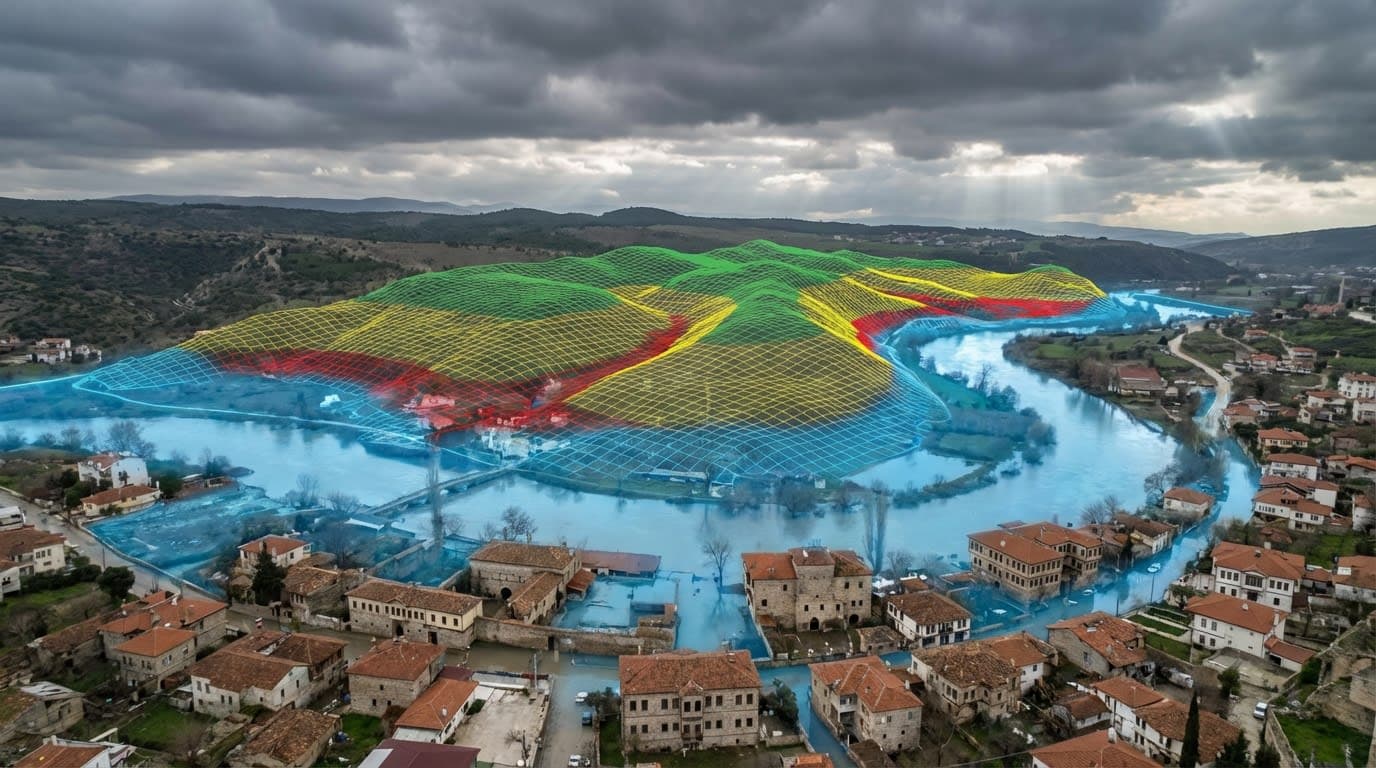
Running a city is a complex process that demands thousands of decisions every day. From where to site a new park to the optimal locations for ambulance stations, most of those decisions have a spatial dimension. Geographic Information Systems (GIS) make these spatial decisions data-driven — and form the backbone of smart cities.
Why GIS is the Backbone of Smart Cities
The smart city concept describes delivering urban services more efficiently, sustainably and citizen-centrically through technology. Making that vision real requires data from different sources to meet on a shared spatial reference. GIS provides exactly that integration layer.
Population data, infrastructure inventories, transport networks, green spaces, energy consumption and environmental measurements become meaningful when tied to location in GIS. Population density on its own is a number — overlay it with parks, hospitals and transit lines, and strong conclusions about service accessibility emerge.
Decision Support System Components
A GIS-based decision support system comprises:
- Spatial database: queryable, updatable infrastructure storing all geographic data in standard formats
- Analysis modules: buffer, network, density and suitability analysis tools
- Visualization layer: thematic maps, 3D visualizations and interactive dashboards
- Integration interfaces: real-time data feeds from IoT sensors, weather stations and other sources
- Reporting and presentation: concise, visual reports for decision makers
Combined, these components let municipal leaders answer complex questions quickly: "Where should the new school go?", "Which neighborhoods lack green space?", "Which roads may be unreachable after an earthquake?"
Use Cases
GIS-based decision support systems apply to nearly every municipal service:
- Zoning and planning: producing land-use maps, zoning conformance analysis, density control
- Transport: traffic density analysis, transit route optimization, bike-lane planning
- Environmental management: air quality monitoring, noise mapping, waste collection route optimization
- Social services: population density analysis, accessibility assessments for health and education
- Infrastructure management: water loss/leakage analysis, lighting inventory management, road maintenance planning
- Disaster management: risk mapping, evacuation planning, damage assessment and reporting
Each use case produces spatial insights by overlaying different data layers in GIS. Those insights replace intuition with evidence.
National Standards and TUCBS
The Turkish National Geographic Information System (TUCBS) standardizes spatial data sharing and interoperability across the country. TUCBS data themes include:
- Address and building data
- Cadastral and ownership information
- Transport networks
- Hydrography and water resources
- Land cover and land use
- Administrative boundaries
- Elevation data
Aligned with the EU INSPIRE directive, TUCBS guarantees that data produced by municipalities is shareable at national and international scales. Building GIS-based decision support systems to TUCBS standards avoids duplication and strengthens inter-institutional collaboration.
Verigo's Contribution
At Verigo Digital Engineering we play an active role in building and strengthening municipalities' GIS infrastructure. High-accuracy spatial datasets produced from LiDAR and photogrammetry form the base of decision support systems.
Across our projects we integrate land-use maps, population density analyses, infrastructure inventories and 3D city models into a single spatial analytics platform for municipalities. We also provide technical consulting on TUCBS-compliant data production and sharing.
Smart cities are built with smart decisions. GIS-based decision support systems deliver the right data at the right time in the right format — the key to creating more livable cities.