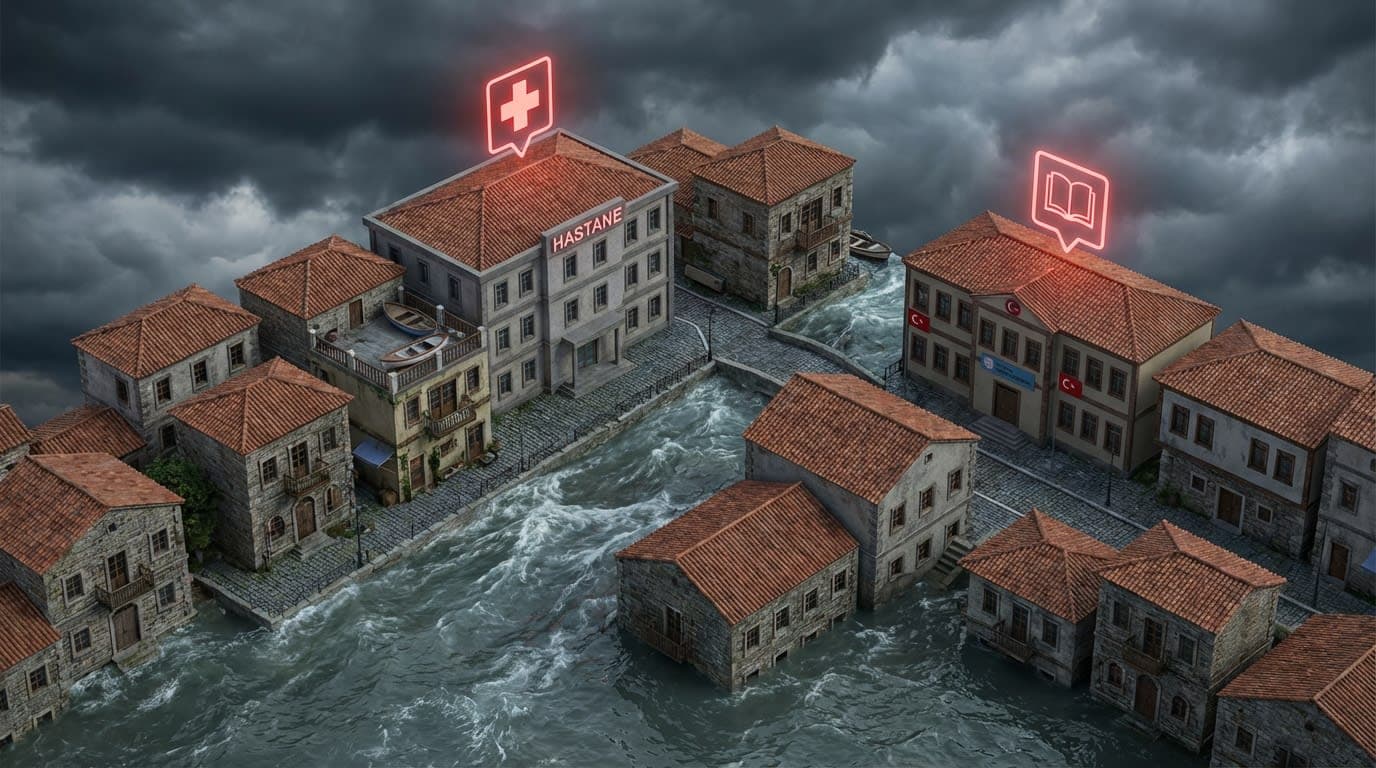
Turkey, due to its geographic location and climate, is one of the countries most exposed to flood disasters. AFAD data shows more than 100 flood and inundation events annually, causing billions of liras in property damage and loss of life. The Black Sea region, the Marmara and Mediterranean coasts rank among the most critical areas in terms of flood risk.
Is it possible to reduce the impact of these disasters? The answer lies in flood risk maps and the spatial analyses performed in advance.
What is a Flood Risk Map?
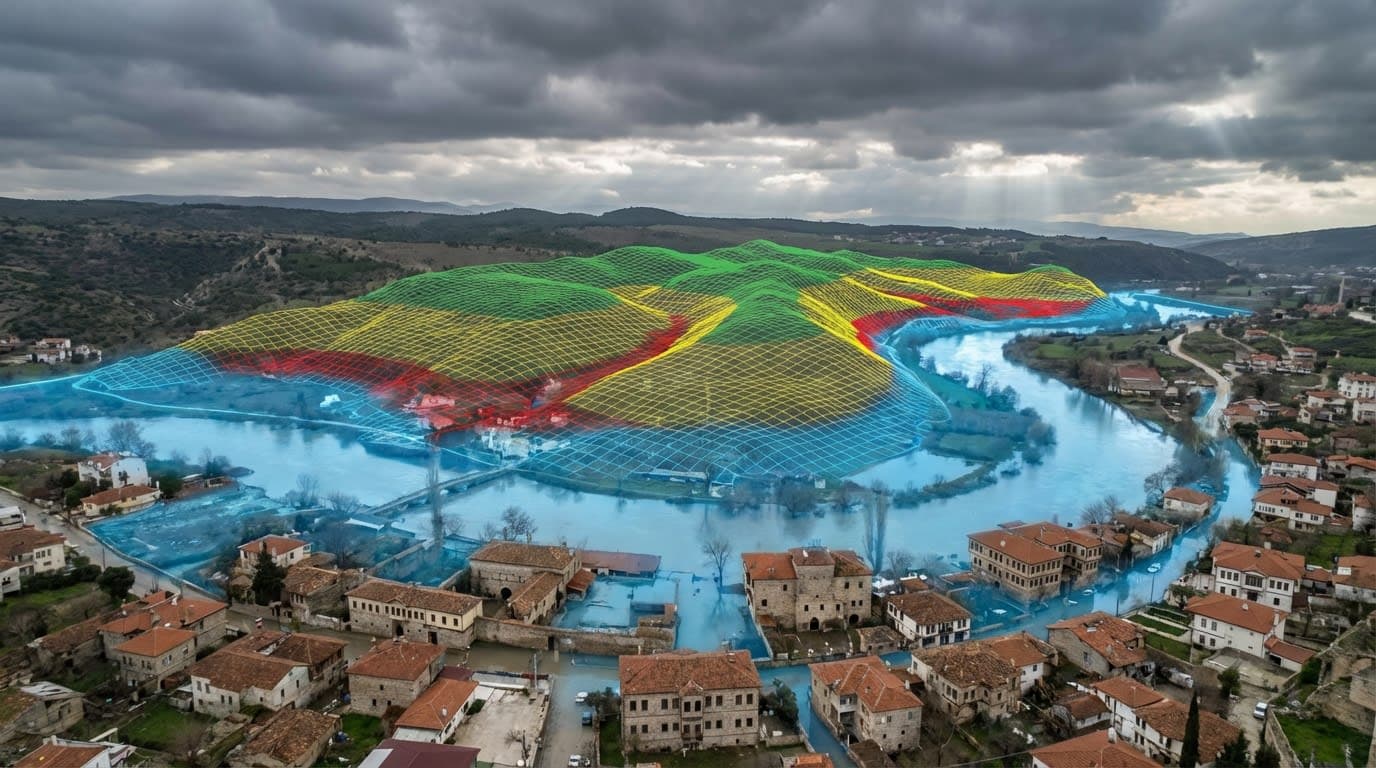
A flood risk map is a spatial analysis product that shows where water will spread under given precipitation scenarios in a region, which settlements are at risk, and how deep the flood will be. These maps are a core component of the Flood Management Plans run by DSİ (Turkey's State Hydraulic Works).
Why LiDAR Data is Critical
The accuracy of flood modeling is directly tied to the precision of the terrain data used. Traditional topographic maps offer 1-5 meters of accuracy, whereas aerial LiDAR scanning produces digital terrain models (DTM) at centimeter precision. That precision gap is vital for correctly computing flood extent, especially in low-slope coastal regions.
LiDAR point clouds separate the bare-earth model from surface objects such as vegetation and buildings. As a result, the real geometry of streambeds, hydraulic cross sections under bridges and culverts, and slope gradients are determined to millimetric accuracy.
How is GIS-Based Flood Analysis Performed?
Flood risk analysis is carried out by overlaying multiple data layers in a GIS (Geographic Information System) environment. These layers include:
- Digital terrain / surface models (DTM/DSM)
- Precipitation and discharge measurements
- Land use maps
- Geology and soil permeability data
- Slope and aspect analyses
- Drainage network and watershed boundaries
Hydraulic modeling software such as HEC-RAS uses cross-section data produced in GIS to compute water surface profiles for different return periods (Q50, Q100, Q500). Results are imported back into GIS to produce flood extent maps.
Flood Management Plans in Turkey
In line with the EU Water Framework Directive, Turkey is preparing flood management plans for all 25 river basins. Each basin's plan produces flood hazard and flood risk maps. Coordinated by DSİ, this work provides a basis for municipal zoning plans and directly shapes construction decisions.
Under the National Water Plan 2026-2035, the goal is to establish a National Flood Forecasting and Early Warning System across every basin by 2030. The system will forecast up to 72 hours ahead, supported by AI-based methods.
Verigo's Approach
At Verigo Digital Engineering, as part of the Eastern Black Sea Flood Project, we produced high-resolution LiDAR data and digital terrain models of the region. Using those models we ran flood simulations, identified at-risk settlements and delivered decision-support data to local governments.
Flood risk maps are the cornerstone of a proactive — not reactive — disaster management approach. With the right data, the right model and the right analysis, loss of life and property can be prevented.