Turkey — sitting at the intersection of three biogeographic regions (Mediterranean, Euro-Siberian and Irano-Turanian) — is one of the most biodiverse countries in the world. Protecting this geography, home to more than 12,000 plant species, over 800 bird species and thousands of endemics, is of national and global importance. Effective management of protected areas depends on accurate, current and comprehensive spatial data.
Why Spatial Data Matters
Protected area management requires evaluating several ecological, social and economic factors together across large geographies — a task that is impossible without spatial data. Core data needs include:
- Boundary verification: checking whether legal boundaries of protected areas match the ground reality
- Land cover and land use: current distribution of forests, pastures, agriculture, settlements and water bodies
- Habitat classification: mapping the spatial limits of different ecosystem types
- Change detection: identifying shifts in land cover over years and running trend analysis
- Human pressure: mapping threats such as illegal construction, agricultural expansion and deforestation
LiDAR, multispectral imaging and GIS form a complementary technology stack for producing this data.
Forest and Vegetation Analysis with LiDAR
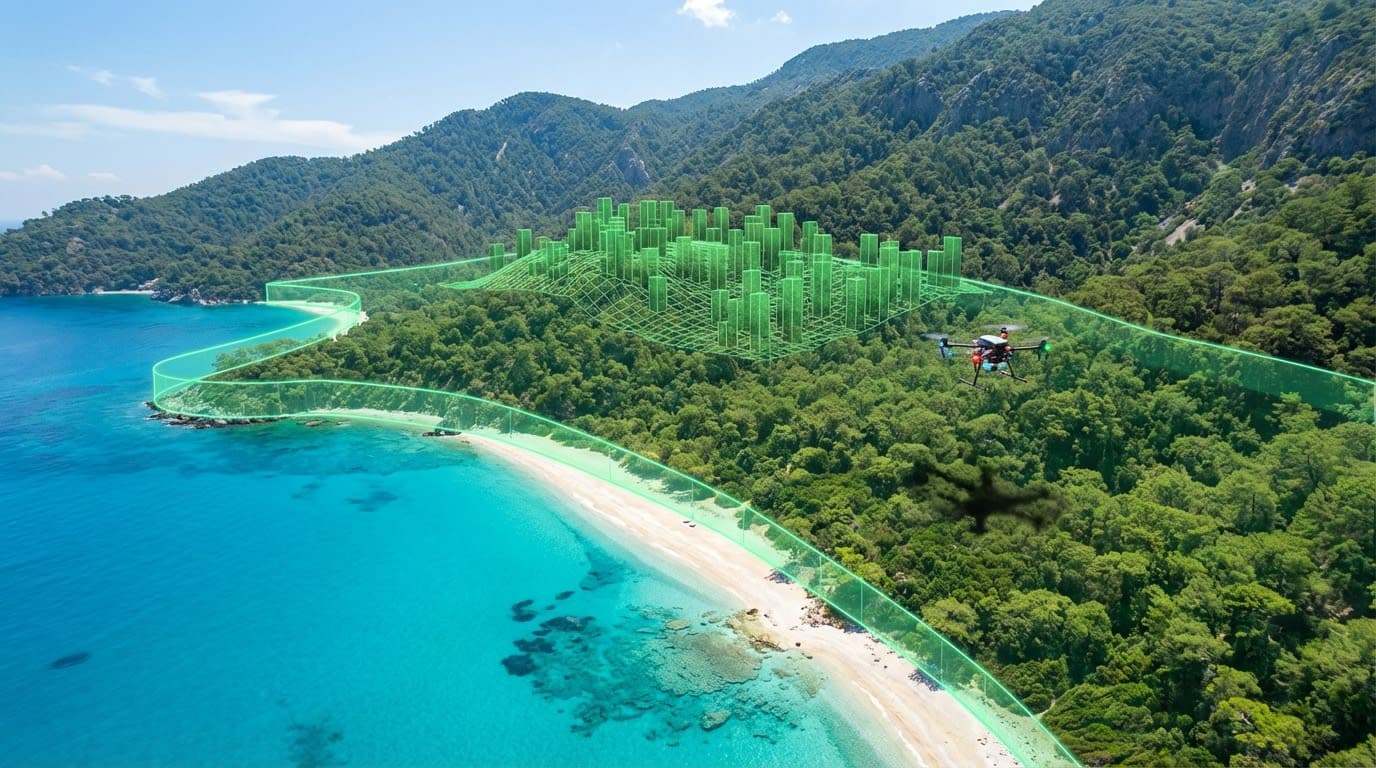
Aerial LiDAR is a transformative technology for forest and vegetation inventory. Traditional field surveys are sample-based and time-consuming — LiDAR scans large areas quickly and with high precision.
Key products derived from LiDAR in forested areas include:
- Canopy height map: using nDSM (DSM - DTM) to determine each tree's height to centimeter accuracy
- Canopy closure: quantifying canopy density and gap distribution
- Biomass estimation: computing carbon stock and biomass from tree height and crown diameter
- Forest structure classes: separating single-story, multi-story and mixed structures
- Fire damage assessment: post-fire vegetation and topographic change analysis
LiDAR's key advantage is that laser pulses can penetrate the canopy to reach the ground — yielding data on sub-canopy topography and understory vegetation that aerial photography cannot provide.
Multispectral Imaging and NDVI
Multispectral cameras capture imagery in wavelengths invisible to the human eye — particularly the near-infrared (NIR). The most common index derived from this data is NDVI (Normalized Difference Vegetation Index).
NDVI expresses vegetation health on a -1 to +1 scale. Healthy, dense vegetation produces high values (0.6-0.9), while stressed or sparse vegetation produces lower values (0.2-0.4). Bare soil and water surfaces are near zero or negative.
NDVI is used in protected area management for:
- Vegetation health monitoring: early detection of areas weakened by drought, disease or insect infestation
- Seasonal change: spatial tracking of phenological phases (leafing, flowering, leaf drop)
- Invasive species: detecting and monitoring the spread of non-native plants
- Rehabilitation tracking: spatially evaluating afforestation and restoration outcomes
Coastal and Aquatic Ecosystem Mapping
Turkey is surrounded by seas on three sides, with an 8,333 km coastline. Mapping and monitoring coastal ecosystems is a core component of protected area management.
Coastal and aquatic ecosystems demand diverse spatial data:
- Dune systems: coastal dune boundaries, morphological change and vegetation state
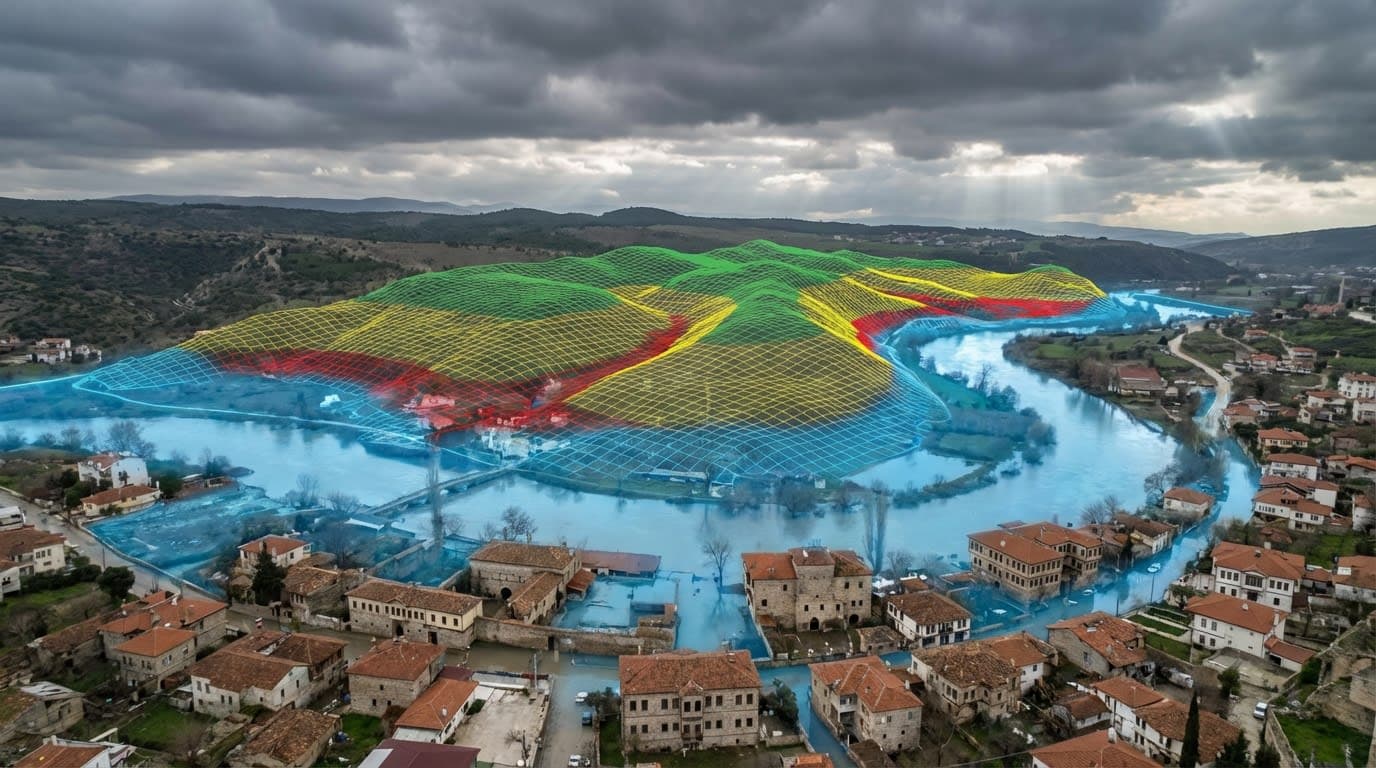
- Wetlands: water-level changes in lakes, lagoons and reed-beds, plus land-cover and bird habitat mapping
- Coastal erosion: annual tracking of shoreline change driven by sea-level rise and wave action
- Seagrass meadows: detecting the distribution of species like Posidonia oceanica
Bathymetric LiDAR enables mapping of the seabed in shallow waters. Green-wavelength pulses pass through the water surface to the bottom, yielding centimeter-accurate subsurface topography. The technology offers a major advantage for inventorying coral reefs, seagrass meadows and coastal habitats.
Verigo's Environmental Projects
At Verigo Digital Engineering we conduct comprehensive environmental mapping within Special Environmental Protection Zone (ÖÇKB) projects. These projects produce high-resolution orthophoto maps, 3D terrain models and vegetation classification maps of protected areas using aerial LiDAR and multispectral imaging.
The outputs are integrated into GIS to form the basis of protected area management plans. Habitat maps, land-cover change analyses and human-pressure maps give decision makers a scientific foundation for conservation strategy.
Conservation starts with knowing. Spatial data from LiDAR, multispectral imaging and GIS is the most reliable way to understand ecosystems — and to pass them on to future generations.